

AI Sprint Grant recipients on helping math students use AI more productively
Launched earlier this year, the CU system Artificial Intelligence (AI) Sprint Grant: AI for Teaching & Learning is focused on improving course outcomes using AI with goals of supporting and accelerating innovative teaching practices that leverage AI to enhance student learning.
The grant is designed to provide faculty with the resources and time needed to develop and implement AI-driven pedagogical strategies for the specific purpose of increasing student performance relative to the learning goals/outcomes of a single course. The ‘sprint’ structure is designed to meet the pace of AI evolution, and in doing so, foster an environment of experimentation and growth with meaningful, of-the-moment outcomes toward improving student learning.
To learn how to apply for the next round of Sprint AI Grants, please see details at the end of this feature.
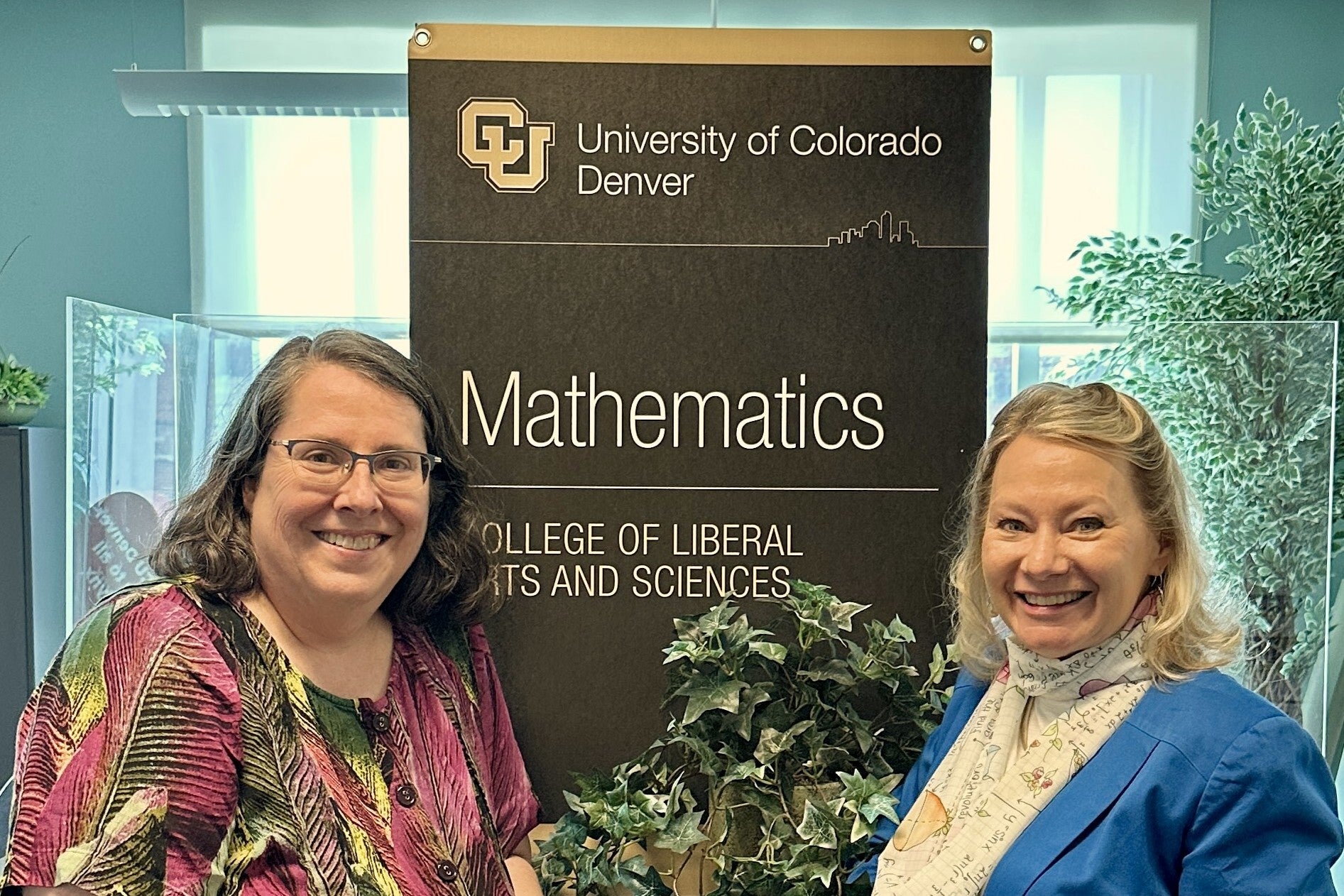
Among the projects receiving grants earlier this year was “Using MathGPT.ai to Enhance Student Success in Calculus,” led by Diana White, associate professor, and Pamela Whitten, senior instructor, of CU Denver’s Mathematics and Statistical Sciences Department. The project will integrate MathGPT.ai into Calculus I at CU Denver to address high rates of unsuccessful course completion in a key gateway course for STEM and other quantitatively intensive fields.
Q&A with Diana White and Pamela Whitten
Q. What initially inspired you to apply for the AI Sprint Grant?
A. White: Calculus I has historically had a high DFWI (grade of D or F, withdraw or imcomplete) rate. I’ve attempted to moderate this for several years in the hybrid (online, asynchronous, but with in-person written exams) version of the course. Despite significant research-based modifications, student performance was not improving. I wanted to explore whether AI could provide individualized support to students.
I had also worked on an NSF proposal involving MathGPT.ai, so I was already familiar with the platform and how the embedded AI tutor works. Rather than producing solutions (in fact, it will not solve the problem), it asks questions and guides students through the reasoning needed to solve each problem. That’s much closer to how we want students to learn mathematics.
Q. Can you describe your project and how you hope using AI will help students achieve the learning outcomes in your course?
A. White: We are replacing our current online homework system with MathGPT.ai, which is built around the same OpenStax textbook we already use. Students still complete homework online, but now they also have access to an embedded AI tutor that can guide them through problems whenever they get stuck. The tutor is available 24/7 and provides instant support. Our goal is to determine whether this kind of immediate, scaffolded support leads to stronger learning and improved success in Calculus I.
Whitten: As the Calculus I course coordinator, I’ve seen the course evolve from using written homework to online homework platforms, then to OER, and now toward the AI component. Staying current with that shift should benefit students, especially once they learn how to use the tool properly.
Q. What ideas, research, or experiences have influenced your approach?
A. Whitten: After teaching Calculus I for decades at both the high school and university levels, I’ve noticed that students generally are already using new technology and are generally up to speed on it. I think getting them to take what they already know how to do and enhance it so that they use it better is a good thing, and it should help improve their success.
White: A key idea for me is productive struggle. Students need to get to the point where they are stuck and then work through how to get unstuck, and the AI tutor is designed to help with that. The tutor can help narrow down where they need support.
I also think about active learning, which we know greatly enhances student learning. Today, students seem to have fewer study partners and study groups, so they lose some of that mathematical interaction. Talking to a chatbot is not the same as talking to another human, but it is still interaction about the mathematics, with students being asked to articulate their progress and their understanding of where they are in working through a problem.
Q. What AI tools are you planning to use and what led you to choose those particular tools?
A. White: We considered building our own AI solution, as some faculty both locally and nationally have done, but we ultimately concluded that a dedicated platform was more sustainable. MathGPT.ai already integrates with our textbook, has ongoing development and technical support, and is being used by many institutions. We are not software developers, so rather than developing a basic tutor that is separate from the online learning management system, and then needing to maintain and enhance that tutor, we preferred to evaluate a platform that could realistically be adopted more broadly if it proves effective. The future of AI tutoring in mathematics is probably not a bunch of separate one-off systems developed by individual faculty members. It is more likely to be something that a company or open-source group develops and continually improves.
We decided to go that direction and wrote the grant to pilot it this summer. We have already been using it for about a month or two, which has helped us work through the setup before the fall.
Q. How will you know that your project has been successful? What evidence will you look for to understand its impact on student learning?
A. Whitten: We are definitely looking at DFWI rates. While we cannot completely attach that to the AI component, we are already noticing a positive difference this semester using the MathGPT.ai platform.
White: We’ll compare DFWI rates and performance on exams, including the common final administered across all Calculus I sections. Because every section takes essentially the same final using the same grading rubric, it provides a useful comparison across sections, modalities, and instructors.
We’ll also analyze how students actually use the platform, examine relationships between AI use and performance, and survey students about their experiences. Together, these data should give us a much richer picture than grades alone.
More broadly, I hope we learn not only whether AI improves outcomes, but also how to teach students to use it effectively as part of the learning process rather than as a shortcut.
Q. What are you most excited about? What are you uncertain about?
A. Whitten: The uncertainty for me is whether using the AI platform will make a difference. I am hoping it will. I am excited for students to use it and try something new.
White: I am excited to see if the AI tutor can genuinely improve learning rather than simply make work easier. If we can identify ways AI can be infused in courses to support students in becoming stronger mathematical thinkers, then those lessons could extend well beyond this one course. I also am excited to keep tweaking our use of the platform and to think through how to support students in using AI productively so that it moves their learning forward.
My biggest uncertainties are whether improvements will be present, detectable and attributable to and for which students this support makes a detectable difference.
Q. How do you envision your project being adopted or adapted by instructors in other courses or even other disciplines?
A. White: Independent of the AI tutor, I like the MathGPT.ai interface and setup better than the MyOpenMath one, and in theory we could switch to it more broadly. We also ended up getting free access for the entire department for the semester, which makes it easier to explore. The main challenge after that is cost and how to keep materials affordable for students.
Whitten: From a course coordinator’s perspective, the interface is much more user-friendly. It is easier to set up and easier for one instructor to copy a course from another instructor without having to start over from scratch. That kind of workflow could make it easier for others to adopt.
White: If the results are positive, I think the model could transfer readily to other introductory mathematics courses and to disciplines that rely heavily on guided practice and frequent feedback. One advantage of using a commercial platform rather than a custom-built system is that other instructors could realistically adopt it without developing their own AI tools.
We also plan to share what we learn through venues such as COLTT, the Rocky Mountain Section of the Mathematical Association of America, and potentially practitioner-focused publications so others can build on our experience.
How to apply for the next round of Sprint Grants
The CU system Office of Academic Affairs, in partnership with the Office of the President, invites faculty to apply for a systemwide grant recognizing and supporting innovative uses of artificial intelligence (AI) in teaching and learning across all CU campuses. These grants are not specific to any single AI platform or tool.
The CU System Sprint Grant: AI for Teaching & Learning is focused on improving course outcomes using AI with goals of supporting and accelerating innovative teaching practices that leverage AI to enhance student learning. This grant is designed to provide faculty with the resources and time needed to develop and implement AI-driven pedagogical strategies for the specific purpose of increasing student performance relative to the learning goals/outcomes of a single course. The ‘sprint’ structure is designed to meet the pace of AI evolution, and in doing so, foster an environment of experimentation and growth with meaningful, of-the-moment outcomes toward improving student learning.
This fall 2026 call for proposals represents the second of three sprint grant cycles.
Eligibility: Tenured or tenure-track faculty and full-time and instructional series faculty are eligible to apply.
Amount: Up to $20,000 and may be used to cover project expenses, which can include support toward one course buyout.
Deadline: Apply by Oct. 16, 2026.